Nitrogen dynamics in an experimentally eutrophied boreal lake
Eutrophication is the world’s most widespread water quality problem, resulting in cyanobacteria blooms, oxygen depletion, release of cyanotoxins, fish kills and decreased quality of drinking water, all of which have important implications from a fisheries and lake management perspective. High phosphorus (P) concentrations have been identified as one of the key factors resulting in eutrophication of lakes, and as a result regulations and controls have been implemented in an effort to reduce P loading to freshwaters. However, there is still considerable debate as to whether nitrogen (N) should be similarly regulated as this nutrient may also play an important role in controlling algal biomass and lake eutrophication. This research was conducted at the world renowned Experimental Lakes Area as part of a whole-lake P fertilization experiment that has been on-going for 40+ years and my objective was to determine whether N is an ultimately limiting nutrient (on a seasonal time scale) for algal growth in eutrophied lakes and, therefore, whether costly treatment of waste water to remove N would be an efficient and effective means of managing lake eutrophication. To answer this question, the research team examined key processes in the cycle of N and P nutrients, including fixation of atmospheric N2, atmospheric N deposition, sedimentation of N and P, and recycling of organic matter in the sediments to release nutrients back into the overlying waters. Preliminary findings suggest that although the lake is fertilized with only P and not N, primary production is not ultimately limited by N, as N nutrients are supplied through a combination of N2 fixation (the single most important source of N), and return from the epilimnetic and hypolimnetic sediments (together equal to ~1/3 of all N sources).
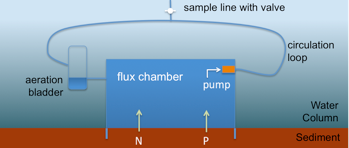
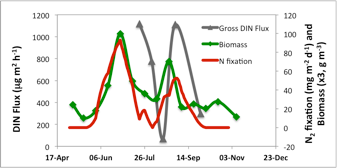
| Measuring nutrient return from shallow sediments. I used light and dark flux chambers deployed on epilimnetic sediments to measure net and gross return of P and N nutrients, including dissolved inorganic nitrogen (DIN; sum of ammonium, nitrate and nitrite). Release of nutrients from shallow sediments exhibited a temporal pattern that was offset from the timing of algal blooms and peak N2 fixation by a couple of weeks, suggesting very rapid recycling of N nutrients within Lake 227. |
Carbon cycling in Arctic freshwater ecosystems
Arctic wetlands, ponds and lakes are common features on the Arctic landscape, providing valuable resources to wildlife and humans. These systems also act as biogeochemical hotspots, and can be very productive. Rates of ecosystem productivity dictate how much energy flows through foodwebs, impacting the abundance of higher-level organisms (e.g., fish), as well as he net carbon balance, controlling whether a particular system is carbon source or sink. This research strives to obtain a process-level understanding of ecosystem productivity and respiration, in order to better understand how climate-induced changes in hydrology (change in precipitation patterns, timing of ice-out and snowmelt, deepening of the active layer overlaying permafrost, etc.) and catchment vegetation (increased vegetation cover, shifts in plant community structure) are impacting carbon cycling dynamics and Arctic freshwaters ecosystems on both the short and long-term. I am using various tools and approaches to examine carbon cycling in Arctic ponds and lakes,including novel stable isotope techniques to examine current rates of primary production and respiration, sediment cores and paleolimnologicaltechniques to examine the response of productivity and lake ecosystems to climate change as well as current ecosystem scale fluxes of greenhouse gases across the air-water interface to determine whether these systems are sources or sinks of CO2, CH4, N2O, etc.
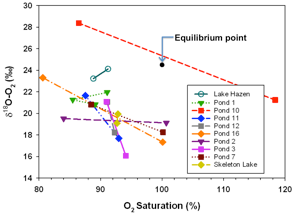
| Quantifying ecosystem metabolism using oxygen isotopes. Along with colleagues at the University of Waterloo, I am developing ways to quantify whole-pond primary production and community respiration using stable isotopes of oxygen. This figures shows how stable-isotopes provide additional information not available through traditional methods. Even though the ponds are undersaturated in dissolved oxygen, suggesting that respiration dominates, the stable isotope signature of this dissolved oxygen is depleted showing a clear photosynthesis fingerprint. |